Structural Drying & Dehumidification in Lutz, FL
Surfaces dry in a day; drywall, block and slab hold water for much longer. The drying team sizes air movers and dehumidifiers to each room and keeps them running until the readings, not the calendar, say the structure is dry.
(888) 621-2041Walls still damp days later? Call.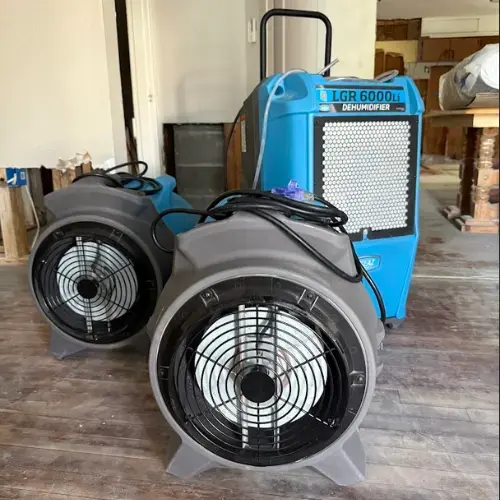
First steps for structural drying in Lutz
Keep the AC running
If power is safe, it helps pull humidity down.
Leave equipment in place
Moving or unplugging fans stalls the drying.
Keep doors closed
So dehumidifiers work on the wet rooms.
Watch the readings
Ask to see the daily log.
How the Lutz team handles structural drying
Moisture mapped first
The tech who does the walkthrough reads walls, slab and cabinets with pinless meters and thermal imaging before any fan goes down.
IICRC S500 drying standard
The drying team works to IICRC S500, the industry drying standard: structural drying, not just surface drying.
Claim-ready documentation
Daily readings, drying logs and timestamped photos build the file an adjuster reviews.
Lutz water experts
Slab leaks on karst ground, pool home lanais, summer roof leaks and septic backups are routine work north of Tampa.
What does structural drying cost in Lutz, FL?
In Lutz, FL, structural drying typically runs $1,100 to $6,500 on its own. The drivers are the class of loss, how many rooms need equipment, how dense the wet materials are, and how many days the equipment runs.
Class 1 or 2, one area
$1,100 to $2,300
- Air movers and one LGR unit
- Daily readings
- Three to four days
Class 3, several rooms
$2,300 to $4,600
- Multiple LGR units
- Wall cavity drying
- Four to six days
Class 4, block and slab
$4,600 to $6,500+
- Desiccant dehumidifiers
- Slab and block drying
- Drying log for the claim
For a closer planning figure, run the Lutz water damage cost calculator. A firm number comes from the on-site walkthrough.
The structural drying process in Lutz, start to dry
Four stops, in the same order on every job.
- 1
Walk and map
The tech who does the walkthrough traces where the water went, room by room, and marks the wet edge.
- 2
Extract
The extraction crew pulls standing water first, usually with truck-mounted units.
- 3
Dry to the load
Air movers and LGR dehumidifiers run at the load each room needs, with readings every day.
- 4
Verify dry
Equipment comes out when readings sit within 2 to 4 points of a dry reference material.
Structural drying is the part of a water loss that decides whether a house is truly dry or only looks dry. Drywall, block walls, wood framing, cabinets and a concrete slab all hold water inside them. In the humid air north of Tampa, moisture does not leave on its own; it has to be pulled out of the materials and then out of the air.
How the drying is set up
- The tech who does the walkthrough maps every wet material and picks a dry reference in an unaffected part of the house.
- The class of loss, Class 1 through 4, sets how many air movers and dehumidifiers each room needs.
- Air movers sweep wet surfaces to speed evaporation; LGR (low grain refrigerant) dehumidifiers pull that moisture out of the air.
- Dense Class 4 materials such as block, plaster and hardwood often need desiccant dehumidifiers.
- Wall cavities and cabinets get directed airflow through small openings instead of being torn out.
Daily readings and the drying goal
Most crews record readings every day: moisture content of the materials plus temperature and relative humidity, the psychrometric data that shows the air is doing its job. Equipment comes out when wet materials read within 2 to 4 points of the dry reference. That record goes in the claim file and shows exactly when the structure reached the goal. A contained Class 1 loss usually dries in three to five days; slab and block take longer.
Why it matters after a Lutz loss
Slab leaks, lanai water and storm losses all leave water in concrete and block, the slowest materials to dry. Stopping too early leaves moisture that shows up later as swollen baseboard, lifting tile or growth behind drywall. Estimate the timeline with the drying time estimator, or see water extraction for the step before drying.
Indoor humidity and moisture basics from the EPA indoor air quality program and home energy and cooling upkeep from Energy Saver.
Structural drying across Lutz and the lakes north of Tampa
The Lutz restoration crew covers Cheval, Lake Fern, Crenshaw Lake, old Lutz along US 41, Sunlake Boulevard and Heritage Harbor, plus Land O' Lakes, Odessa and Carrollwood, ZIP codes 33548, 33549, 33558 and 33559.
Every neighborhood and ZIP coveredRelated water damage services in Lutz
Structural Drying and Dehumidification questions in Lutz, FL
What is structural drying?
Drying the materials of the house, including drywall, framing, block and slab, to a measured goal instead of just drying the surfaces.
Why are the fans so loud and running for days?
Air movers speed evaporation from wet materials, and dehumidifiers remove that moisture. Turning them off stalls the drying.
How is dry measured?
Meters compare wet materials to a dry reference in the same house. The goal is within 2 to 4 points of that reference.
What is a desiccant dehumidifier for?
It dries air to a very low humidity, which pulls water out of dense Class 4 materials such as block, plaster and hardwood.
Should the AC stay on during drying?
Usually yes, when power is safe. It helps control humidity; the drying team sets the thermostat for the equipment.
How long does structural drying take?
A contained Class 1 loss usually dries in three to five days. Slab, block and hardwood take longer.
Still damp in a Lutz home? Dry it to the reading.
Moisture left in block, slab and framing shows up later as swollen trim and lifting tile. The drying team works day and night across Lutz and northern Hillsborough County.