Appliance & Supply Line Leak Cleanup in Lutz, FL
A burst washer hose, a dishwasher line or an ice maker tube can run for hours under cabinets and behind walls. The extraction crew pulls the water and the drying team dries the cabinets, toe kicks and floor it reached.
(888) 621-2041Appliance line spraying water? Call.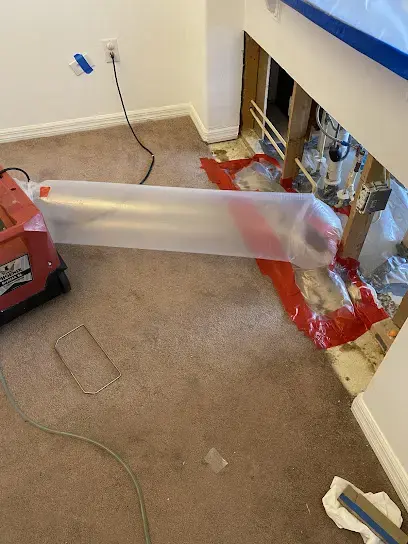
First steps for appliance leak cleanup in Lutz
Close the appliance valve
Or the main if the valve will not turn.
Unplug the appliance
If the outlet and floor are dry.
Empty the cabinet
Under the sink or beside the dishwasher.
Photograph the hose or line
Before it is replaced.
How the Lutz team handles appliance leak cleanup
Moisture mapped first
The tech who does the walkthrough reads walls, slab and cabinets with pinless meters and thermal imaging before any fan goes down.
IICRC S500 drying standard
The drying team works to IICRC S500, the industry drying standard: structural drying, not just surface drying.
Claim-ready documentation
Daily readings, drying logs and timestamped photos build the file an adjuster reviews.
Lutz water experts
Slab leaks on karst ground, pool home lanais, summer roof leaks and septic backups are routine work north of Tampa.
What does appliance leak cleanup cost in Lutz, FL?
In Lutz, FL, appliance and supply line leak cleanup typically runs $700 to $4,800. The drivers are how long the leak ran, whether water got under cabinets and into walls, and whether it was clean supply water or gray drain water.
Caught fast, one room
$700 to $1,500
- Extraction
- Toe kicks off, cabinets dried
- Daily readings
Kitchen or laundry and beyond
$1,500 to $3,200
- Cabinet and wall cavity drying
- Baseboard removal
- LGR dehumidifiers
Slow leak found late
$3,200 to $4,800+
- Flooring or cabinet removal
- Wall cavity opened
- Claim documentation
For a closer planning figure, run the Lutz water damage cost calculator. A firm number comes from the on-site walkthrough.
The appliance leak cleanup process in Lutz, start to dry
Four stops, in the same order on every job.
- 1
Walk and map
The tech who does the walkthrough traces where the water went, room by room, and marks the wet edge.
- 2
Extract
The extraction crew pulls standing water first, usually with truck-mounted units.
- 3
Dry to the load
Air movers and LGR dehumidifiers run at the load each room needs, with readings every day.
- 4
Verify dry
Equipment comes out when readings sit within 2 to 4 points of a dry reference material.
Appliance leaks are among the most common water losses in any home, and they hide well. A washer supply hose can burst while no one is home, a dishwasher line can drip for weeks under the toe kick, and a fridge ice maker tube can leak behind the refrigerator into the wall. Toilet supply lines and fill valves fail too. In Lutz homes with tile over a slab, the water runs under cabinets and baseboard long before it shows on the floor.
Common failure points
- Rubber washer hoses that bulge and burst with age.
- Dishwasher supply and drain connections under the sink.
- Plastic ice maker lines behind the refrigerator.
- Toilet supply lines and fill valves.
How the water damage is handled
The extraction crew removes standing water, then the tech who does the walkthrough reads the cabinet bases, toe kicks, baseboard and walls with pinless meters and thermal imaging. Toe kicks often come off so the drying team can push air under the cabinets, and holes drilled behind the kick plate let air reach the wall cavity. Supply water is Category 1; washer and dishwasher drain water is Category 2 and gets cleaned first. Air movers and LGR dehumidifiers run with daily readings until the goal is met.
Preventing the next one
Braided stainless hoses, a leak sensor behind the washer and dishwasher, and replacing hoses every five years or so stop most of these losses. For a tank failure in the garage or a closet, see water heater leak cleanup. Coverage depends on your policy, so it is worth checking with your own insurer.
Leak checks from EPA WaterSense and appliance safety information from the Consumer Product Safety Commission.
Appliance leak cleanup across Lutz and the lakes north of Tampa
The Lutz restoration crew covers Cheval, Lake Fern, Crenshaw Lake, old Lutz along US 41, Sunlake Boulevard and Heritage Harbor, plus Land O' Lakes, Odessa and Carrollwood, ZIP codes 33548, 33549, 33558 and 33559.
Every neighborhood and ZIP coveredRelated water damage services in Lutz
Appliance and Supply Line Leak Cleanup questions in Lutz, FL
Which appliance leaks cause the most damage?
Washer hoses, because they are under full pressure and can burst while the house is empty. Ice maker lines are a close second because they leak slowly out of sight.
Do the cabinets have to be removed?
Usually not. Removing the toe kicks and drilling small holes lets air dry under and behind them.
Is washer water clean?
Supply water is Category 1. Drain water from a washer or dishwasher is Category 2 and gets cleaned before drying.
How often should washer hoses be replaced?
About every five years, or sooner if they bulge or crack. Braided stainless hoses last longer.
How long does drying take?
Most appliance leaks dry in two to four days. Cabinets and slab under tile can take longer.
Is an appliance leak covered?
Sudden failures are often covered, while slow leaks may not be. Coverage depends on your policy, so it is worth checking with your own insurer.
Appliance leak in a Lutz kitchen? Dry under the cabinets.
Water under cabinets and behind toe kicks stays wet for days without airflow. The extraction crew works day and night across Lutz and nearby communities.